

‘333 by J. Julian Vacas’ Review: A Haunting Descent Into Memory, Mythology and the Underworld
J. Julián Vacas creates a dialogue-free journey through grief, ritual and ancient evil, combining striking locations with ambitious visual effects and a hypnotic experimental style.
333 by J. Julian Vacas immediately announces that it will not behave like a conventional horror film.
After opening with a quotation from Ronnie James Dio, the title appears with a strong gothic identity before the film moves into a vast, desolate landscape. The atmosphere is already mysterious: open land, heavy skies and a woman whose dreams seem to connect her with someone no longer living.
Selena remains trapped in mourning after the death of her sister, Estela. Surrounded by memories, symbols from ancient civilizations and the dog Estela left behind, she becomes determined to cross the boundary between life and death. Her search leads her toward an invocation and into an underworld controlled by the winged creature Pazuzu.

That is all the story needs to reveal. 333 is best experienced as a descent rather than a plot explained through dialogue.
Director J. Julián Vacas — known to many as Jota Jota — builds the film almost entirely through images, sound, music and editing. This is the second of his films I have watched, and once again his creativity is impossible to ignore. He is a filmmaker who enjoys constructing worlds and finding unusual ways to move an audience through them.
The early images of Selena and Estela create a dreamlike connection between the sisters. Selena appears haunted not simply by a supernatural presence, but by memories she cannot release. The film moves between grief, recollection and ritual until it becomes difficult to separate emotional reality from the underworld she is entering.
Ines Klein and Egle Krasauskaite both have a strong cinematic presence. Their faces, movement and stillness carry the emotional information that dialogue would normally provide. Klein, in particular, guides the film through Selena’s mourning, obsession and determination without needing to explain the character’s thoughts aloud.
The cemetery sequence is one of the film’s strongest passages. A tracking shot follows Selena as she walks among the graves, giving the location a sense of movement and purpose rather than treating it as a simple horror backdrop. The framing throughout these scenes is carefully considered, using tombstones, pathways and open space to reinforce her isolation.
Location scouting is a major strength across the entire film. Cemeteries, empty landscapes, gothic architecture and cavernous environments all contribute to the feeling that Selena is passing through different stages of a spiritual journey. These places look as though they belong to the mythology instead of merely serving as available locations.
Vacas also repeatedly finds memorable compositions. A winged silhouette rises above gothic architecture. Hooded figures gather inside smoky darkness. Ghostly faces appear in the sky. Floating rocks and tilted landscapes make the physical world feel unstable. Selena and Estela stand within wide, desaturated spaces that resemble memories already beginning to disappear.
Pazuzu remains a recurring presence throughout the film. Sometimes the creature is clearly visible; elsewhere, it appears as a shadow, an emblem or an oppressive figure watching over the environment. This repetition gives the impression that Selena is never moving freely through the underworld. She is being observed and possibly guided toward something she does not yet understand.
The visual effects are ambitious and, most importantly, they support the atmosphere. Independent fantasy and science-fiction filmmaking can be unforgiving when VFX are not integrated properly. Poor effects can immediately break the illusion of an otherwise serious film. J. Julián Vacas understands that problem and once again delivers imagery that feels connected to the same visual world.
The effects do not aim for clean realism. Instead, they embrace an experimental, layered quality. Smoke, double exposures, spectral figures, embers and distorted landscapes overlap as though we are watching a nightmare assembled from fragments of memory.
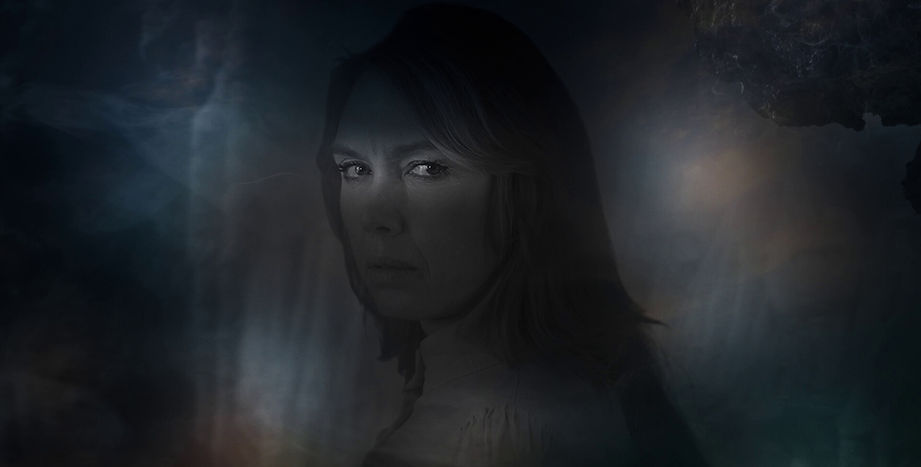
That approach gives 333 by J. Julian Vacas its identity.
The mostly monochrome and desaturated palette creates a world suspended between life and death. Occasional warmer tones appear like traces of fire, memory or human warmth trying to survive inside the darkness. The images are gothic, mythological and sometimes reminiscent of illustrations from an ancient forbidden text.
Sound design and music are essential because the film contains no dialogue. Every transition, apparition and change of environment depends on audio to guide the audience. The sound creates scale around images that might otherwise feel abstract, while the music establishes the emotional rhythm of Selena’s journey.
The editing is equally important. J. Julián Vacas knows when to remain with an image and when to move rapidly through visions, memories and ritual fragments. The final sequence is especially impressive, bringing together the sisters, hooded figures, supernatural imagery and visual effects in a dense but controlled montage.
Although 333 by J. Julian Vacas is experimental, it never feels accidental. The director clearly understands where each image, sound and cut belongs. The absence of dialogue is not a limitation or a stylistic trick. The film simply does not need words. Its story is communicated through grief, faces, movement, symbols and atmosphere.

Selected for the Los Angeles Fantasy Fest 2026, 333 by J. Julian Vacas is a special piece of Spanish independent science-fiction horror. It is visually imaginative, emotionally mysterious and technically ambitious, offering thirteen minutes of pure cinematic world-building.
J. Julián Vacas continues to prove himself as a filmmaker with a highly creative mind and a distinctive visual voice. He is unquestionably a director to watch — not only within Spanish independent cinema, but far beyond it.
Production Details
Director and writer: J. Julián Vacas
Cast: Ines Klein, Egle Krasauskaite and J. Julián Vacas
Characters: Selena, Estela and Pazuzu
Country: Spain
Language: No dialogue
Year: 2026
Runtime: 13 minutes
Genres: Science fiction, horror and experimental
Format: 4K, color, 16:9
By Darwin Reina 27 July 2026
Share!