

The Silent Treatment — When Silence Speaks Louder Than Words
The Silent Treatment — When Silence Speaks Louder Than Words
There are films that rely on dialogue to guide you, explain things, hold your hand. And then there are films like The Silent Treatment — a short that does the exact opposite. It strips everything down to the essentials and trusts the audience to feel.
At just over nine minutes, this Klens UK production directed by Steven Lancefield drops us into a situation that feels simple on the surface… but quickly turns into something deeply tense, uncomfortable, and painfully real. This is a film about domestic abuse — not the loud, explosive kind we often see on screen, but the quiet, suffocating kind. Emotional control. Psychological manipulation. The kind that leaves no visible scars, but cuts just as deep.
And what makes this film stand out immediately is this: there is no dialogue.
None.
But you don’t miss it for a second.
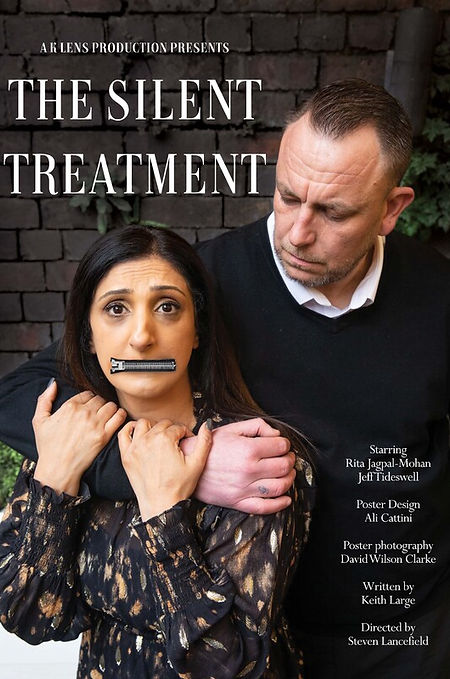
The storytelling is carried entirely through performance, framing, music, and atmosphere — and it works. It really works. Every look, every movement, every pause tells you exactly what’s happening. The silence becomes the language. And in many ways, it hits harder than words ever could.
Rita Jagpal-Mohan, playing Jayia, delivers a truly outstanding performance. There’s no other way to put it. She carries the emotional weight of the film with precision and honesty. You feel her fear. You feel her isolation. You feel that quiet suffering that so many people unfortunately live through in real life.
It’s not exaggerated. It’s not overplayed. It’s real.
And that’s what makes it uncomfortable — in the best possible way.
Opposite her, Jeff Tideswell as Nick plays the antagonist in a way that is disturbingly effective. You hate him. You genuinely hate him. And that’s a compliment. Because he embodies that type of person so well — the kind of abuser who doesn’t need to shout or hit to control someone. The coldness, the tension, the presence… it’s all there.
There’s a particular strength in how the film builds tension through everyday situations. A restaurant scene stands out — not because something dramatic happens, but because of how much is communicated beneath the surface. It’s beautifully constructed. You see everything without anything being said.
Visually, the film is sharp. The framing is thoughtful. The locations are well chosen, giving the story a grounded, real-world feel. Even technically demanding moments — like the car scenes and chase sequences — are handled impressively for a short film of this scale. They feel natural, not forced, and they elevate the pacing without breaking the tone.

And then there’s the music.
Subtle. Emotional. Perfectly placed.
It guides you without overpowering the story, enhancing the silence rather than replacing it.
But beyond the craft, what really stays with you is the message.
The Silent Treatment is not just a film — it’s a statement.
It highlights a form of abuse that is often overlooked. It reminds victims that they are not alone. And more importantly, it shows the importance of support — especially the strength of women supporting each other. That thread runs quietly through the film, but it’s powerful. Because sometimes, the only way out of silence… is someone reaching in.
This project is backed by well known producer Keith Large, whose presence here is important very important. You can feel that this is not just another short film — it’s part of a bigger intention. A voice. A direction. With previous work across multiple projects, it’s clear he’s building something with purpose, and The Silent Treatment fits right into that trajectory.

This is a film that doesn’t try to impress you with noise or spectacle.
It sits with you.
It makes you uncomfortable.
It makes you think.
And most importantly, it makes you feel.
Because sometimes, the most dangerous words… are the ones never spoken.
Share!